Newsroom
From Minister of Information to the UN: Aicha Thiendella Fall’s Journey into Global Security
May 4, 2026
5 min read
(Pour lire cet article en français, cliquez ici.)
There is a report that lands on the desk of senior United Nations leadership that synthesizes global security developments affecting humanitarian operations. Somewhere in the chain that produces that report is Aicha Thiendella Fall, Reporting Officer at the UN's Global Center of Security Information, based in Dakar.
It is a role of striking weight and precision, and it suits her perfectly. Those who have watched Aicha's trajectory from the shores of Gorée Island to Equitech Futures’ Civic Tech Institute will recognize something unmistakable in how she has arrived here: a lifelong instinct for gathering, synthesizing, and transmitting the information that others need to act.
The Girl with the Books
Aicha grew up in Dakar as the firstborn child of a family that placed learning at the center of everything. Her father was a lawyer, and from the earliest age, studying was simply what you did. "Thank God I actually enjoyed it," she says. "I don't know how it would have gone if I didn't."
She was a reader before she was a student. A French television show taught her the alphabet at around age four. By the time she started school, just before turning five, she could already read well enough to skip a grade. When her father didn't see her with a book for two or three days, he would start to worry something was wrong. Her uncle, a teacher, kept her supplied with new ones.
By the time she was ten, that hunger for learning had earned her something remarkable: a place at Maison d’Education Mariama Ba, the elite secondary school that admits only the top 25 girls nationally based on entrance exam scores. The school sits on Gorée Island, and for the first time in her life, Aicha left home. "It is one of the first defining moments of my life," she reflects. "You are there with people who are excellent. Everyone is smart. Everyone studies well."
But the island school gave her more than academic rigor. It gave her a first encounter with organized civic life — and a role she would grow into more fully than she could have known at the time. Within her class's small student government, she was elected Minister of Information. "I really loved interacting with people, giving information, very early on," she says. She was also the one who bridged the shyness between younger students and the older girls who served as informal mentors. "I was that one who was so outgoing. I would just collect the information, go to the person, be like, ‘okay, she wants you to be her godmother.’ We used to write each other letters, and I would be taking the letters between them."
Across Continents, Building a Foundation
While still in secondary school, Aicha won national academic prizes in both Spanish and Latin before earning admission to the African Leadership Academy in Johannesburg at sixteen. She arrived knowing little English. Through what she now calls "a blessing in disguise," she was accidentally placed in an advanced writing and rhetoric class intended for fluent English speakers. She didn't realize the mismatch for months. By then, it didn't matter. Her English had accelerated far beyond what a remedial track would have allowed. "After four months," she says simply, "I was really okay."
At ALA, surrounded by brilliant young people from across the continent, she began to form the ambition that would run like a thread through everything that followed. She had grown up watching Africa's potential go unmet. The answer she found at ALA: the missing ingredient was cooperation, blocked by narrative. "The rhetoric, the stories we have about Africa and about African countries — to me, they were just not good enough for us to cooperate and develop." Diplomacy, she decided, was the tool. Story and information were its currency.
She chose Ashoka University in India for her undergraduate studies in political science and international relations, deliberately picking a path away from the US or Europe. Her professor Ananya Sharma was transformative, and just as importantly, the faculty pushed her to write about her own history, not just India's. She wrote about the slave trade. Being the only international student in most of her classes, she also came to understand her African identity more clearly, including which stereotypes were worth correcting and which battles to leave alone. "I realized," she says, "that you can't fight all battles." She has continued to choose them carefully ever since.
Into the Field
Back in Senegal, Aicha cycled through roles that, taken together, built the foundation of everything to come. Her manager and mentor at Impact Hub Dakar, Abdoul Aziz Sy, gave her space to grow as an entrepreneurial coach and project manager. "He gave me the space to fall down and get back up," she says. At Paradigm Initiative, she became the sole Senegal-based staff member covering all of Francophone West Africa, and encountered the field that would shape her most: digital rights. She came to understand internet access as one of the most urgent equity issues of her generation. "With the slave trade and colonialism, we lost 500 years while others were going forward. But with this new tool, it almost brings everyone to the same level." An ALA fellowship then placed her in the Office of the Special Envoy on Women, Peace and Security at the African Union Commission in Addis Ababa, deepening her grounding in continental diplomacy. It was there, trying to hold onto her passion for the digital rights space while doing something entirely different, that she found her way to Equitech Futures.
The Civic Tech Institute: A Lifeline
"The Civic Tech Institute was my lifeline," Aicha says without hesitation. She enrolled in the 2024 cohort while mid-fellowship at the African Union Commission. The timing was precise. The evening classes landed at the end of her workday, allowing her to participate fully. "It was still connecting me to the digital rights space while I was doing something entirely different." In a year of diplomacy and logistics work, the institute was the place where she could think and talk about technology: how it shapes citizenship, how it can be governed, how it ought to serve people. She found in her cohort colleagues of genuine rigor. "Really committed people doing wonderful things. The conversations were high level. They made me think, question a lot."
The technical depth of Abhilash Mishra's AI coursework addressed a gap she had long identified in civil society work. "The digital rights space is full of people from civil society. We like to write and speak, but we are not engineers. The technical part sometimes evades us." That changed for her at the Civic Tech Institute, and she has carried it forward directly: when she trains civil society organizations today, she begins with foundational AI literacy. "What is AI? How does it work? What is the background? That was thanks to the Civic Tech Institute."
The communications coursework made an equally lasting impression. "It was the first time I went into a class and someone said: just write, write anything." At the time, Aicha was also ghostwriting speeches for her principals at the African Union Commission. The ability to put thought clearly onto the page — under pressure, for audiences ranging from heads of delegation to field officers — was not a soft skill. It was the job.
Keeping the Peacekeepers Safe
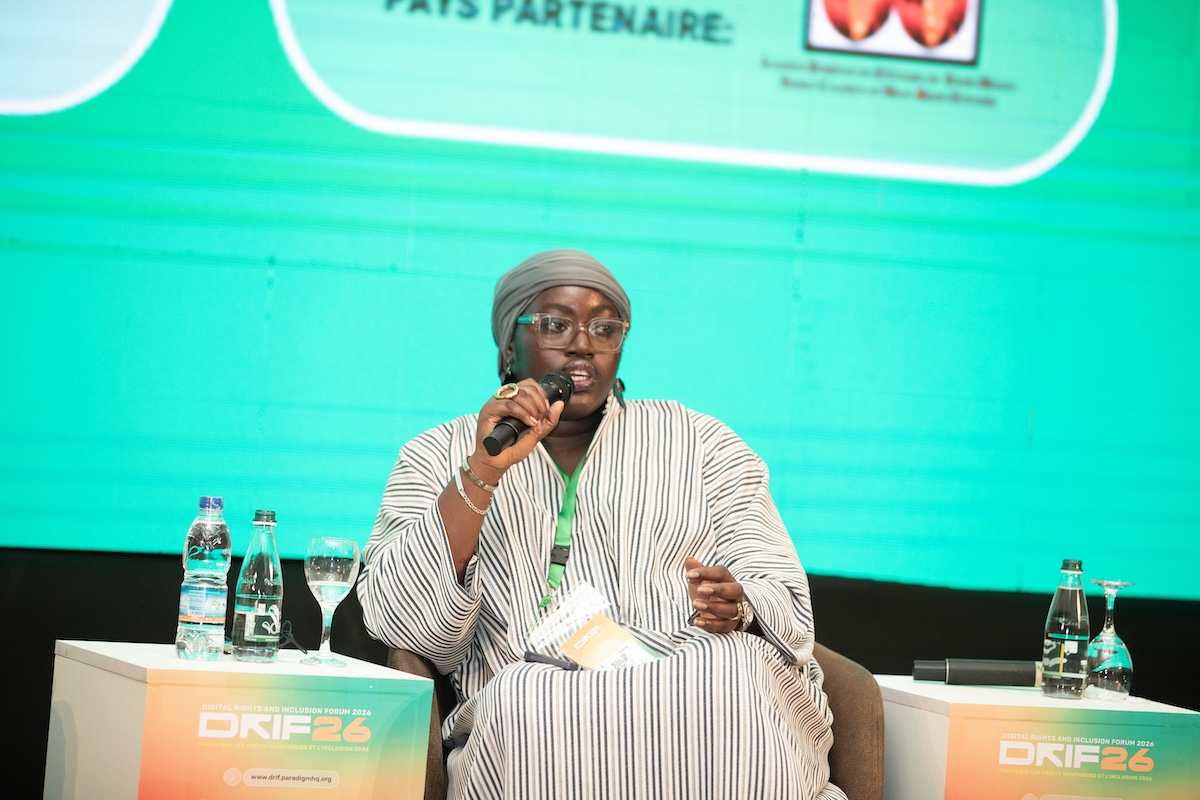
Today, Aicha is part of a 24-hour team in which she collects field reports, identifies incidents affecting the UN, monitors media for emerging threats, and synthesizes everything into the morning brief. "All of this comes into a report that goes on the desk of UN leadership and stakeholders by 8 a.m. New York time."
The demands of the role crystallize every skill she has accumulated. Political awareness: she must understand who is fighting and why before she can assess whether an incident is routine or a signal requiring escalation. She covers East Africa with particular focus, where the scale of suffering in places like Sudan is something daily monitoring makes viscerally clear. "The Sudan war is not being circulated as much as the Iran war, even though the casualties are not even comparable." Information literacy: speed and accuracy must coexist without compromise in an environment saturated with disinformation. "You have to go and check; be sure that's the right information. Because you don't want to alert people and have them mobilize resources when it's not true. You have to give it in a language accessible to all."
Three years ago, a psychometric assessment told Aicha she was "a pure strategist." She was skeptical at the time. Her work had been so hands-on, so community-facing. The role has vindicated it. "When I'm working and getting information, I'm realizing how fast I'm connecting things — how fast I'm asking questions internally, like, is this linked to that? What is the point that is missing?"
The psychological toll is real, and she is honest about it. She has always reacted viscerally to injustice. "I hate injustice so much. Having that in my face, knowing that at that specific point in time there is nothing I can do about it — it's just not easy." What she holds onto is purpose: accurate information, reaching the right people in time, saves lives. "If you are sending the right information, and people are aware, they have better mitigation strategies. They can actually protect UN personnel based on this." It is the bigger picture that makes the daily weight both bearable and meaningful.
The symmetry is undeniable. The ten-year-old elected Minister of Information in the student government now contributes to the security reporting that informs how the United Nations protects its personnel across complex environments. The throughline is not accidental. It is, as she has always understood it, the work.
The Knowledge That Endures
Aicha's closing thought was addressed not to her own achievements, but to the people who might read about them and feel diminished by comparison. "LinkedIn might make you feel like you are not doing enough. The things that you are doing might not look like they are having an impact, but they do."
She draws this conviction from her faith. In Islam, she explains, there are categories of action that continue to earn reward even after death: a pious child who prays for you, a charitable act that goes on being used, and knowledge you transmitted to someone who continues to use it. "If today I am teaching you something — how to write — and you are writing for 70 years, the reward of those 70 years still comes back to me. My love of learning has now translated into my love of transmitting knowledge — in any way possible."
For Aicha Thiendella Fall, Equitech Scholar and Reporting Officer at the United Nations, the Minister of Information has never really left office. She has simply found a larger constituency to serve.
Written by


More articles

.jpeg)












Newsroom
Otieno Collins Junior Reflects on His Journey from Capstone Project to Prize-winning Startup


.webp)




.webp)


.webp)


.webp)
Newsroom
No Innovator Left Behind: How Equitech Futures uses philanthropic capital to maximize impact


Newsroom

.webp)


.webp)

.webp)


.webp)


.webp)


.webp)


