Newsroom
Apollinaire Abi Selected as Obama Scholar
Sep 15, 2026
5 min read
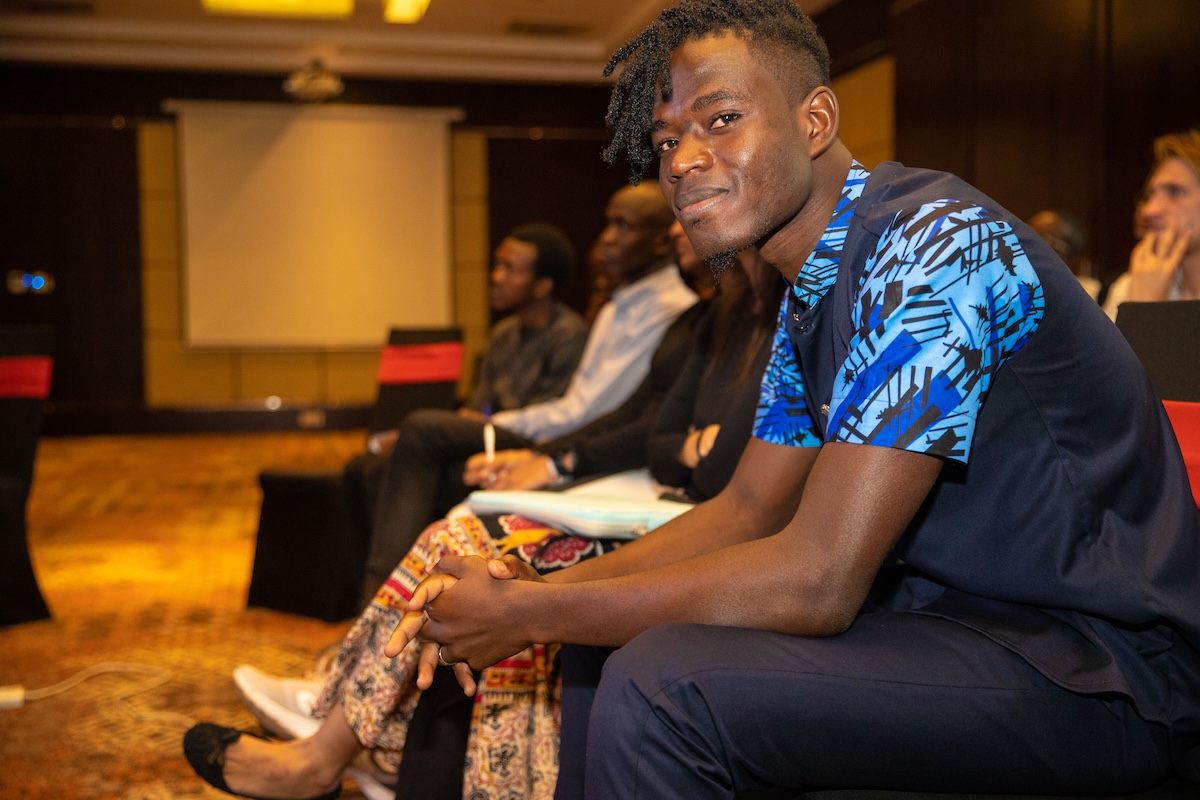
Apollinaire Abi was sitting inside the headquarters of the World Bank in Washington, D.C., partway through a summer internship, when the email arrived. He had been named a 2026-2027 Obama Foundation Scholar, one of a small cohort at the University of Chicago. He shouted.
"I couldn't believe it," Apollinaire said. "It was insane."
Today, watching a video in which President Obama personally welcomed the new cohort, the feeling returned even stronger than it had that day at the World Bank. "It feels unreal," he said. "It feels like I am officially part of something he is really trying to achieve."
For Apollinaire, an Equitech Scholar and a second-year student in the Master of Science in Computational Analysis and Public Policy (MSCAPP) program at the University of Chicago's Harris School of Public Policy, the designation marks a milestone in his journey, carried along at nearly every turn by people who saw something in him before he saw it in himself.
Schooling Changed Everything
Apollinaire grew up in Kara, in northern Togo, and attended the country's Lycée Scientifique, a government school built to train the nation's top young scientists. He was twice recognized as Kara's best mathematician at his age level. But he struggled without reliable internet access or any relatives who pursued higher education. He stole hours at internet cafés researching scholarships instead of studying, a practice which worried his family. Almost no one around him believed the opportunities he was chasing online were real.
One of them was. Apollinaire was admitted to the African Leadership Academy (ALA) near Johannesburg, a school built around the idea that education should be reinvested in the communities that need it most. "That is the one stop that changed everything for me," he said. "It was never again about getting a good job or being rich. It became about how this applies to the community I grew up in, and how it helps Togo fight poverty."
He arrived in South Africa with limited English. He was surrounded by a blur of unfamiliar accents and lessons he could barely follow. One night he burst into tears, and was consoled by a student passing by, Aicha Thiendella Fall, a French-speaking classmate from Senegal. Their friendship, forged before either had heard of Equitech Futures, has run through nearly every chapter of Apollinaire's story since.
Mathematics to Impact
Apollinaire and Aicha chose to attend Ashoka University in India together, where Apollinaire studied mathematics and helped lead the university's international students organization alongside her. It took him four years after ALA to find what he calls the "intersection" of his mathematical passion and his commitment to social impact, arriving there in 2022, when a former Ashoka classmate, Clinton Manoti, pushed him to apply for the Equitech Futures Institute. Clinton had just finished Equitech’s Applied Data Institute.
Apollinaire nearly let the deadline pass. "I told him I would be fine without it. I was applying for jobs, and the fellowship could be a distraction I didn't need," he recalled. "Clinton smelled that it was going to be a game changer for me." He was right. Apollinaire’s interview with members of the Equitech Futures faculty, which probed how Apollinaire thought through problems rather than how quickly he could write code, reframed his understanding of what working with data could mean. "It's about making the right calls," he said.
That summer, Apollinaire met Clinton and fellow Equitech Scholar Andrew Kimani, both from Kenya. All three were taught by Abhilash Mishra, Equitech Futures' founder, whose sessions on applied artificial intelligence left a lasting impression. When the program ended, the three approached Abhilash with an idea: they wanted to build an African chapter of Equitech Futures. Abhilash pushed back, and encouraged them to build something of their own, rooted in what the continent needed. He committed to being an early board member, and Equitech Futures provided seed funding to launch the venture.
The result was NawiriTech, a venture built to close gaps in statistics and data science education across the African continent. Apollinaire became its academic lead, designing curricula that made mathematics principles easier to understand, such as tracing theorems back to the human stories behind them.
A Research Partnership
As NawiriTech grew, so did Apollinaire's collaboration with Abhilash. He brought Abhilash a question rooted in his own upbringing: why did mobile money usage lag so far behind in West Africa compared to East Africa, even where access was nearly universal? Equitech Futures funded a survey of roughly 1,200 mobile money users across Togo, and the resulting paper, "Digital Divide 2.0: When Digital Access Doesn't Translate to Digital Inclusion," co-authored by Apollinaire, Kexin Xu, and Abhilash, found that technical friction and inefficient learning, more than mistrust, explained most of the gap between owning a mobile money account and using it.
It was in the middle of that research partnership that Abhilash recommended Apollinaire apply for the Kabir Banerjee Predoctoral Fellowship at the University of Chicago. A few months later, Apollinaire arrived in Chicago to work with Prof. Oeindrila Dube at the Kevin Xu Initiative at the Harris School, drawn also by the fellowship's ties to Nobel laureates Michael Kremer, Abhijit Banerjee, and Esther Duflo. He had never even Googled Chicago before the fellowship offer came through. "Yet I was getting everything I wanted," he said. Two years later, in the fall of 2025, he began the MSCAPP program at Harris, where he now leads the school's Data, Ethics and Policy Conference and The African Perspective.
Friends and Mentors
I asked Apollinaire about the throughline of his successful career so far, and he conceded that his talent for mathematics is not the whole story. Rather, he credits the people who saw his potential before he saw it himself. Clinton suggested applying for Equitech Futures. Abhilash mentored his drive in the classroom, at NawiriTech, and in a fellowship recommendation that opened the door to Chicago. Aicha has been by his side since the day they met at African Leadership Academy. "She knows more about my struggles and successes than anyone in my life," Apollinaire said of Aicha, now a Reporting Officer with the United Nations' Global Center of Security Information. It was Apollinaire who urged Aicha to apply to Equitech’s Civic Tech Institute after he completed his own program in 2022, extending a chain of encouragement running in both directions for years.
Apollinaire is also looking forward to working with Kyel Governor, a philosopher and economic researcher he met at the University of Chicago’s Becker Friedman Institute for Economics. Kyel's conviction that imported development solutions rarely fit African contexts resonated deeply with Apollinaire, who called their partnership one built for the long term. "I found in him someone I could work with for life," he said. During his Obama Foundation Scholars year, Apollinaire will work alongside Kyel continuing to build NawiriTech, helping local institutions across the developing world build the technical capacity to solve their own problems.
The question Apollinaire first encountered at ALA remains close at hand: what are you doing for your community? Nearly a decade later, with an Obama Foundation Scholarship and a University of Chicago public policy degree ahead of him, he is still answering it, one partnership at a time.
Written by


More articles

.jpeg)
Newsroom
From Minister of Information to the UN: Aicha Thiendella Fall’s Journey into Global Security













Newsroom
Otieno Collins Junior Reflects on His Journey from Capstone Project to Prize-winning Startup


.webp)




.webp)


.webp)


.webp)
Newsroom
No Innovator Left Behind: How Equitech Futures uses philanthropic capital to maximize impact


Newsroom

.webp)


.webp)

.webp)


.webp)


.webp)


.webp)


